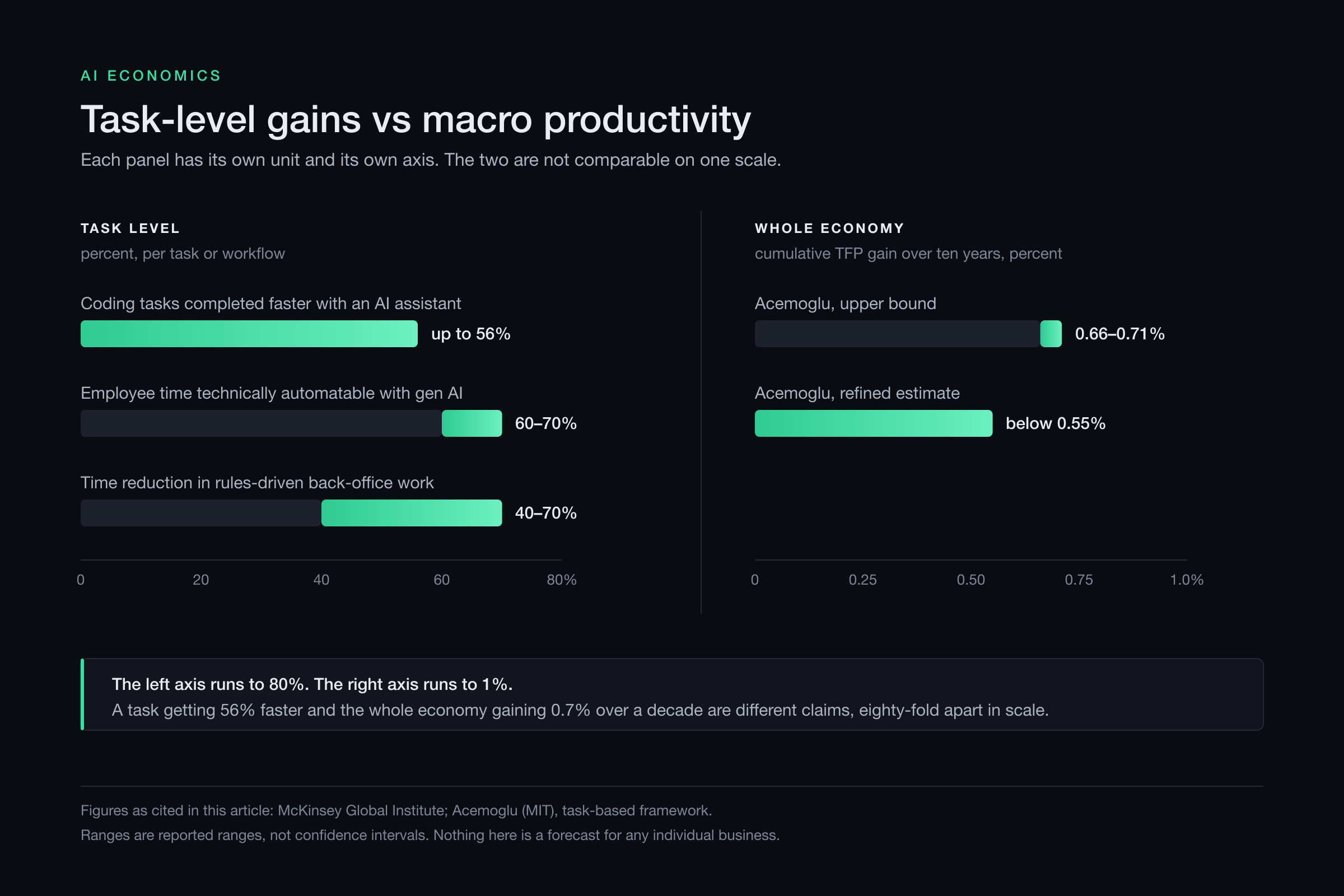
Artificial intelligence is shaping a new economic paradigm that promises a path to cost optimization by multiples through task automation and higher labor productivity. McKinsey estimates generative AI could add the equivalent of $2.6–$4.4 trillion annually to the global economy—raising the impact of AI and analytics by 15–40%—with banking, high tech, and life sciences among the largest beneficiaries as a share of industry revenue. Yet MIT economist Daron Acemoglu projects much more modest macro effects, with cumulative TFP gains of less than 0.55% over a decade under conservative, task-based assumptions. This tension between vendor-led promises and academic projections calls for a close look at the economic mechanisms of transformation.123456
Theoretical foundations: task-based economics
Modern AI economics builds on the task-based framework of Acemoglu and Restrepo, modeling production as a set of tasks allocated between capital and labor. Within this framework, AI affects the economy via four channels:27
- Task automation shifts tasks from labor to AI systems, expanding the frontier of automatable cognitive work; McKinsey’s recent update suggests that 60–70% of employee time is technically automatable with gen AI, up from prior estimates near 50%.14
- Task complementarities arise when AI augments human performance by offloading subtasks or improving information access; early field studies in knowledge work and software engineering show substantial time savings and throughput gains at the task level.61
- Automation deepening improves already-automated processes as models advance, while
- New tasks created by AI can have positive or negative social value; Acemoglu highlights risks from “bad new tasks” (e.g., manipulative content, deception) that add output without social welfare gains.2
Applying Hulten’s theorem, Acemoglu shows that macro productivity depends on the share of tasks impacted and the average task-level cost saving: ΔTFP ≈ (task share impacted) × (avg. cost reduction). Using extant estimates for exposure to AI tasks and measured task-level gains, Acemoglu’s upper bound is about 0.66–0.71% TFP over 10 years, with a refined estimate below 0.55% once hard-to-learn tasks and negative-value tasks are factored in.32
Sectoral impact: where costs compress
- Banking: McKinsey estimates $200–$340 billion annual value if use cases are fully implemented, reflecting efficiencies across customer operations, risk, and compliance. AI assistants and retrieval-augmented advisors for wealth management illustrate rapid knowledge access; Morgan Stanley’s advisor copilot exemplifies GPT-class systems embedded in workflows. Compliance automation and document analytics (e.g., contract parsing) compress cycle times and reduce manual labor in monitoring and reporting.14
- Retail & CPG: Additional $400–$660 billion annually from personalization, demand forecasting, and supply-chain optimization, improving working capital and markdown economics. Gen AI-enabled customer interaction and assortment planning drive both revenue uplift and SG&A efficiencies.41
- Healthcare and life sciences: Tens of billions in annual value from administrative automation, coding and claims optimization, scheduling, and clinical documentation; broader provider-side savings have been modeled at up to 30% in some operations, though realization depends on integration and regulation.891
- Software engineering: Productivity lift equal to 20–45% of current annual spend on the function is plausible at scale, with controlled trials showing developers completing tasks up to 56% faster using AI coding assistants; however, system-level throughput can stall without process redesign.101
Временная шкала внедрения ИИ и ожидаемого экономического воздействия (2024-2030)
Execution risk: why payoffs can lag
- Technical barriers: Data quality and access, integration with legacy infrastructure, and scarcity of specialized talent remain top frictions to enterprise deployment, repeatedly cited across 2024–2025 industry surveys and practitioner reports.1112
- Economic barriers: High upfront compute, tooling, and model-integration costs, alongside uncertain ROI timing, slow capital allocation; spending on AI-enabling infrastructure has surged, but returns often exhibit a J-curve with initial productivity dips.1311
- Organizational barriers: Change resistance, lack of strategic clarity, and compliance constraints raise adoption friction; many firms struggle to scale from pilot to production with measurable business outcomes.1415
The productivity paradox in engineering
Empirical telemetry from thousands of developers shows the “AI productivity paradox”: individual output rises—more tasks completed and more PRs merged—yet organizational delivery metrics may not improve due to review bottlenecks, uneven adoption, and quality variance. Multiple industry analyses corroborate longer review queues and shifting constraints, implying that process, governance, and quality systems must evolve in lockstep with tooling to capture net throughput gains.1610171819
Business model shifts and AI architecture
- AI-as-a-service and platform models reduce CapEx barriers and concentrate value in orchestration, data advantage, and workflow integration layers; three strategic modes—complement, automate, substitute—map to distinct investment and risk profiles at the firm level.12021
- Data network effects increase switching costs and enable value capture as models and embeddings become firm-specific assets; competitive moats arise from proprietary data pipelines and domain-tuned agents integrated with enterprise systems of record.211
- In financial services and back-office operations, RPA-plus-LLM patterns report 40–70% time reductions for high-volume, rules-driven work when paired with human oversight for exception handling and compliance.2223
Labor markets, inequality, and concentration
Acemoglu’s framework predicts that AI-driven productivity does not automatically translate into broad wage gains; even productivity improvements for middle- and low-skill workers may not reduce inequality without complementary task creation and bargaining power shifts. International institutions estimate that roughly 40% of jobs will be affected globally, with heterogeneous complementarity versus substitution patterns across economies and sectors. Absent policy and competition safeguards, control of compute, data, and model distribution can amplify concentration among leading cloud and AI platforms, with asymmetric benefits for advanced economies and frontier firms.22425262728
Governance, ethics, and welfare
The creation of “bad new tasks” (e.g., manipulative content, deepfakes) can inflate output without raising welfare, requiring regulation and platform governance to align private incentives with social value. Policy proposals range from modernized antitrust and data governance to safety assurance, labor-market adaptation, and—under stronger assumptions about AGI—redistributive mechanisms to address potentially extreme shifts in labor’s marginal product.2242729
Strategy: how to realize multiplicative cost optimization
- Design for complements first: engineer workflows where AI removes bottlenecks in information retrieval, summarization, and coordination before pushing full task substitution at scale.130
- Target cost pools with traceability: prioritize customer operations, marketing and sales, software engineering, and R&D—four functions comprising roughly three-quarters of the value pool—and instrument them for causal ROI measurement.41
- Manage the J-curve: expect short-term dips; invest in data quality, process re-architecture, and training to bring organization-level metrics in line with task-level gains.1013
- Build defensible assets: capture data network effects, domain-tuned models, and agentic workflows tightly coupled to systems of record to sustain cost advantages and avoid commoditization.211
In sum, AI enables a new operational paradigm for cost compression via labor substitution and time-to-completion reduction, but macro gains may remain modest without deliberate creation of complementary tasks and institutional adaptation. The path to multiplicative cost optimization runs through systematic workflow redesign, rigorous ROI instrumentation, and governance that aligns private deployment with social value creation.
Footnotes
-
https://www.mckinsey.com/capabilities/mckinsey-digital/our-insights/the-economic-potential-of-generative-ai-the-next-productivity-frontier ↩ ↩2 ↩3 ↩4 ↩5 ↩6 ↩7 ↩8 ↩9 ↩10 ↩11 ↩12
-
https://economics.mit.edu/sites/default/files/2024-04/The Simple Macroeconomics of AI.pdf ↩ ↩2 ↩3 ↩4 ↩5 ↩6
-
https://economics.mit.edu/sites/default/files/2024-05/The Simple Macroeconomics of AI.pdf ↩ ↩2
-
https://www.mckinsey.com/mgi/media-center/ai-could-increase-corporate-profits-by-4-trillion-a-year-according-to-new-research ↩ ↩2 ↩3 ↩4 ↩5
-
https://papers.ssrn.com/sol3/papers.cfm?abstract_id=4843046 ↩
-
https://www.mckinsey.com/industries/technology-media-and-telecommunications/our-insights/beyond-the-hype-capturing-the-potential-of-ai-and-gen-ai-in-tmt ↩ ↩2
-
https://www.nber.org/system/files/working_papers/w24196/w24196.pdf ↩
-
https://msdynamicsworld.com/blog-post/ai-healthcare-how-hospitals-can-cut-operational-costs-30 ↩
-
https://itrexgroup.com/blog/assessing-the-costs-of-implementing-ai-in-healthcare/ ↩
-
https://convergetp.com/2025/03/25/top-5-ai-adoption-challenges-for-2025-overcoming-barriers-to-success/ ↩ ↩2
-
https://www.teksystems.com/en-jp/insights/article/overcoming-ai-implementation-challenges ↩
-
https://mitsloan.mit.edu/ideas-made-to-matter/productivity-paradox-ai-adoption-manufacturing-firms ↩ ↩2
-
https://deepscienceresearch.com/dsr/catalog/book/2/chapter/47 ↩
-
https://www.oecd.org/en/blogs/2025/02/how-do-different-sectors-engage-with-ai.html ↩
-
https://www.linkedin.com/posts/faros-ai_stack-overflow-findings-1pdf-activity-7359648537262870528-CSId ↩
-
https://gradientflow.substack.com/p/rogue-ai-agents-and-productivity ↩
-
https://www.cerbos.dev/blog/productivity-paradox-of-ai-coding-assistants ↩
-
https://www.elsevier.es/en-revista-journal-innovation-knowledge-376-articulo-ai-enabled-business-models-for-competitive-S2444569X24000714 ↩ ↩2 ↩3
-
https://ardem.com/bpo/ai-cost-reduction-with-business-process-automation/ ↩
-
https://www.imf.org/en/Blogs/Articles/2024/01/14/ai-will-transform-the-global-economy-lets-make-sure-it-benefits-humanity ↩ ↩2
-
https://www.oecd.org/content/dam/oecd/en/publications/reports/2024/04/the-impact-of-artificial-intelligence-on-productivity-distribution-and-growth_d54e2842/8d900037-en.pdf ↩
-
https://www.mckinsey.com/~/media/mckinsey/featured insights/artificial intelligence/notes from the frontier modeling the impact of ai on the world economy/mgi-notes-from-the-ai-frontier-modeling-the-impact-of-ai-on-the-world-economy-september-2018.ashx ↩
-
https://www.computer.org/publications/tech-news/trends/economics-of-ai/ ↩ ↩2
-
https://www.globalxetfs.com/articles/paradigm-shifting-technologies-advancing-the-automation-age/ ↩
-
https://www.mckinsey.com/capabilities/mckinsey-digital/our-insights/the-new-economics-of-enterprise-technology-in-an-ai-world ↩