Blog

Engineering articles

Replit-imported articles on AI automation, implementation economics, workflow ROI, manufacturing quality control, and practical AI adoption.

Latest articles

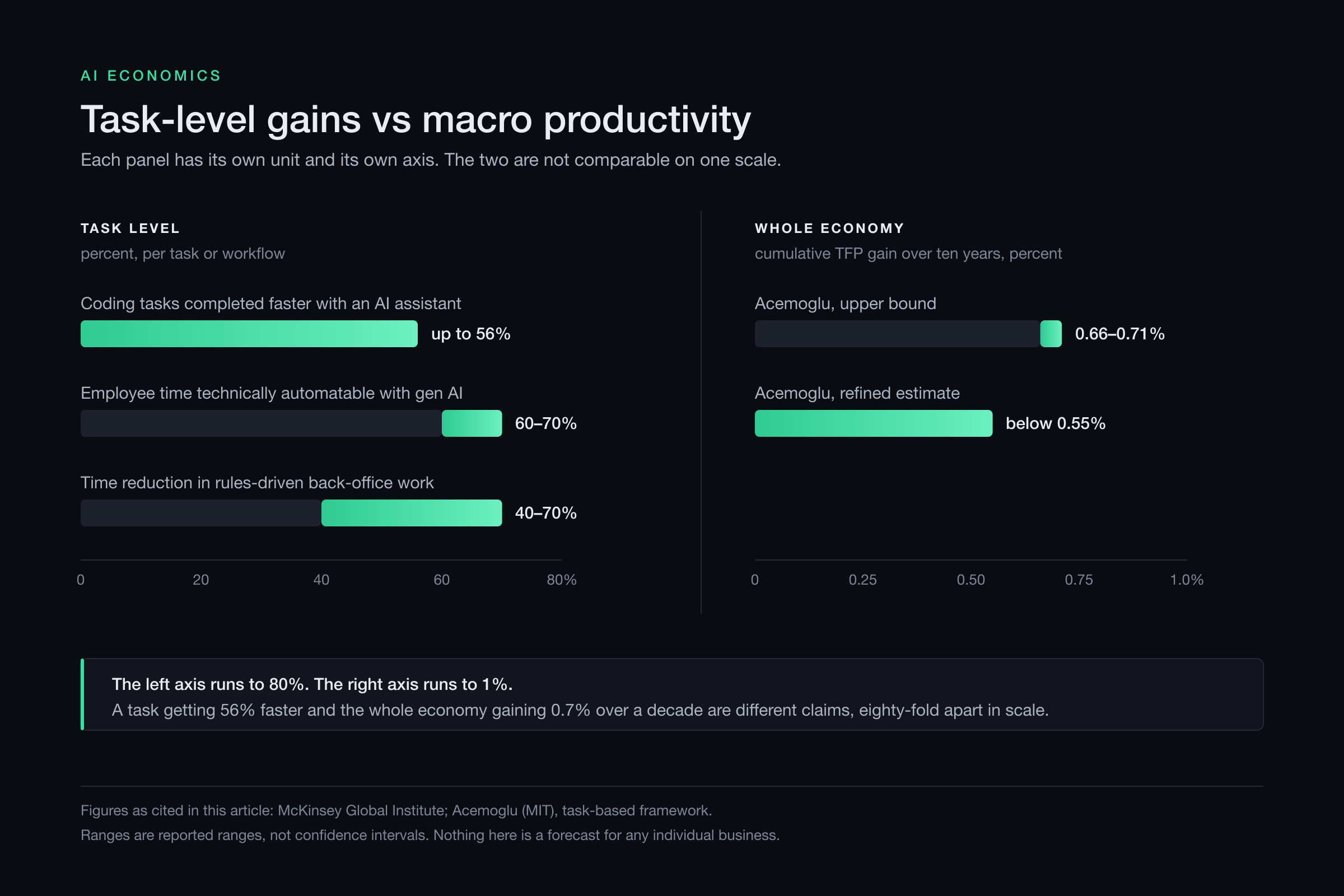
Two-panel chart. Left panel: task-level effects on a nought to eighty percent axis. Right panel: cumulative ten-year TFP gain on a separate nought to one percent axis

A new paradigm on established economics: multiplicative cost optimization in business operations via labor savings and cycle-time reduction with AI

Artificial intelligence is shaping a new economic paradigm that promises a path to cost optimization by multiples through task automation and higher labor productivity. McKinsey estimates generative AI could add the equivalent of $2.6–$4.4 trillion annually to the global economy—raising the impact of AI and analytics by 15–40%—with banking, high tech, and life sciences among the largest beneficiaries as a share of industry revenue.

Pavel Krieger

Article cover for 10 Steps to Developing an Effective AI Implementation Roadmap

10 Steps to Developing an Effective AI Implementation Roadmap

AI is no longer optional: companies that systematically explore at least one high-value use case improve EBITDA by 5-15% within two years ^1^2. Success hinges on groundwork—vision, data, and governance—more than on algorithms ^3^4. A phased, low-risk approach lowers costs, builds skills, and sustains executive sponsorship.

Pavel Krieger

Isometric payback path: tiles sit below a break-even line during payback, cross at a marked node, then rise above the line as returns accumulate

Calculating the True ROI of Workflow Automation

Workflow automation is no longer a speculative technology investment. Done well, it generates measurable cash returns, compresses payback periods, and frees scarce talent for higher-value work. This report equips CFOs with a step-by-step financial framework, current benchmark data, and risk-adjusted evaluation methods to support board-level decisions on automating enterprise processes.

Pavel Krieger

Isometric inspection line: identical parts travel under a scanning beam, one part is lit as it is inspected, and one part is diverted below the line

How AI is Transforming Manufacturing Quality Control

Artificial Intelligence is fundamentally reshaping manufacturing quality control, delivering measurable impacts on operational efficiency and product excellence. Companies implementing AI-driven quality control systems report 30-60% improvements in defect detection and 50% reduction in inspection costs while achieving accuracy rates of up to 99.9%.

Pavel Krieger

Article cover for Implementation Consulting: Your Bridge to AI Success

Implementation Consulting: Your Bridge to AI Success

Traditional industries face a stark reality: 70% of AI/automation projects fail, often costing mid-sized companies millions in wasted investment. The difference between success and failure typically lies not in the technology itself, but in how it's implemented. Implementation consultants serve as the critical bridge between strategic vision and operational reality, transforming ambitious AI plans into measurable business results.

Pavel Krieger

Request a task review